


In recent years, we have all witnessed incredible technological progress. The pace of digital development has accelerated significantly, resulting in new solutions and tools that we can use in many areas of our lives – both private and professional. Currently, entrepreneurs are bombarded from every side with ways to develop their business, speed up the execution of tasks by employees, multiply profits or cut costs. In this context business process automation has become an indispensable element of managing the operations of the entire organization, which allows companies to increase their operational efficiency and gain a competitive advantage. By implementing it, companies can not only reduce expenses, but above all, focus their human resources on tasks with greater added value. Ultimately, automation allows companies to operate faster, more efficiently and with greater precision.
What is Business Process Automation? What is BPA?
Automatyzacja procesów biznesowych – w skrócie BPA (Business Process Automation) – these are all activities aimed at using modern technologies to automate tasks in companies with the help of various tools and algorithms. In practice, this means transferring everyday, routine activities that previously required employee involvement to computer systems that perform them faster, better and cheaper. Automation of business processes also helps avoid errors often resulting from the human factor. BPA can cover various areas of a company’s operations – from administrative operations, through sales and marketing, to human resources management. Importantly, business process automation is not limited to simple tasks, such as sending invoices or generating reports. The tools can also take over more complex processes, such as data analysis, supply chain management or team work optimization. BPA is particularly effective in situations where it is about processing a large amount of information or handling many variables.
Business process automation can be implemented in various areas of a company’s operations., such as sales, administration, HR, marketing or customer service. BPA in these departments allows companies to eliminate manual interventions where they are not needed, saving time and allowing employees to be redirected to more important activities.
Automation of business processes does not mean replacing all human tasks.. W niektórych procesach nadal konieczna jest kontrola i wkład ze strony człowieka. BPA is best suited for repetitive tasks that can be fully automated, freeing employees from spending long hours on time-consuming activities.
Discover the benefits of business process automation

Benefits of Business Process Automation there are many and they cover almost every area of the company’s activity. Below are the most important ones:
Scaling
One of the main advantages of automation is the ability to scale a business with virtually no effort. When a company starts to grow, the natural challenge is to increase operational efficiency – without a proportional increase in the number of employees. With a well-calibrated BPA, internal processes keep up with the company’s growth, regardless of the pace at which it occurs. Automation systems can handle more orders, customers and data without the need to hire additional people. As a result, the company can successfully perform more tasks, while usually with virtually no increase in costs.
Efficiency
Automation means doing everything faster – without unnecessary delays resulting from the limitations of human labor. A process that would take hours to manually (such as generating financial reports) can be automated and completed in minutes. Systems run non-stop, which allows tasks to be carried out at any time of the day or night, which further increases operational efficiency.
Savings
One of the most visible (and most desirable) effects of automation is cost reduction. By implementing automation systems, a company reduces the need for manual work, which translates into a reduction in the number of employees required to perform repetitive tasks. Automation of business processes also eliminates errors, which can lead to delays or costly rework. Automation saves the company both time and financial resources that can be allocated to other budget-demanding initiatives.
Data quality
Introduction of data work automation significantly improves their quality. In traditionally conducted processes, natural errors are often made during human work – typos, omitted information or logical errors. Automation systems eliminate this problem. Data is more accurate, more consistent and always ready for analysis. High data quality is the basis for making effective business decisions. BPA allows for continuous work with reliable information in real time.
Faster company monitoring
Automation means immediate generation of reports and analyses – for managers, this means current insight into the company’s condition. Custom-built systems for business easily process data from various departments, creating comprehensive reports in a few minutes. Thanks to this, managers have full control over the course of business processes, and any problems or irregularities can be quickly identified and corrected.
Fewer mistakes
One of the most important effects of automation is a significant reduction in the number of errors. Even the best trained employees are prone to errors, especially in the case of repetitive, monotonous and very detailed tasks. Automation eliminates this problem because it works according to precise, carefully programmed algorithms. Tools process data with an accuracy that humans are unable to achieve, which allows you to avoid costly errors and losses resulting from irregularities in processes.
Team satisfaction
Employees who are freed from monotonous, repetitive tasks thanks to BPA will be able to focus on more creative and strategic activities. Business process automation reduces the number of tedious, routine activities remaining tasks for the team, which in turn leads to increased satisfaction and reduced risk of burnout. Employees who can devote more time to development feel more motivated and engaged in their work, which of course translates into better results for the company.
The best services
Automation of business processes directly translates into improvement of the quality of services offered. Dzięki ciągłemu przetwarzaniu danych, błyskawicznym odpowiedziom na zapytania i niezawodnej obsłudze, klienci szybko otrzymują spersonalizowane wsparcie. Firma oferująca efektywne usługi, na których można polegać, zyskuje lojalność klientów i buduje swoją reputację na rynku.
Where will process automation be most effective, i.e. which processes should be automated?
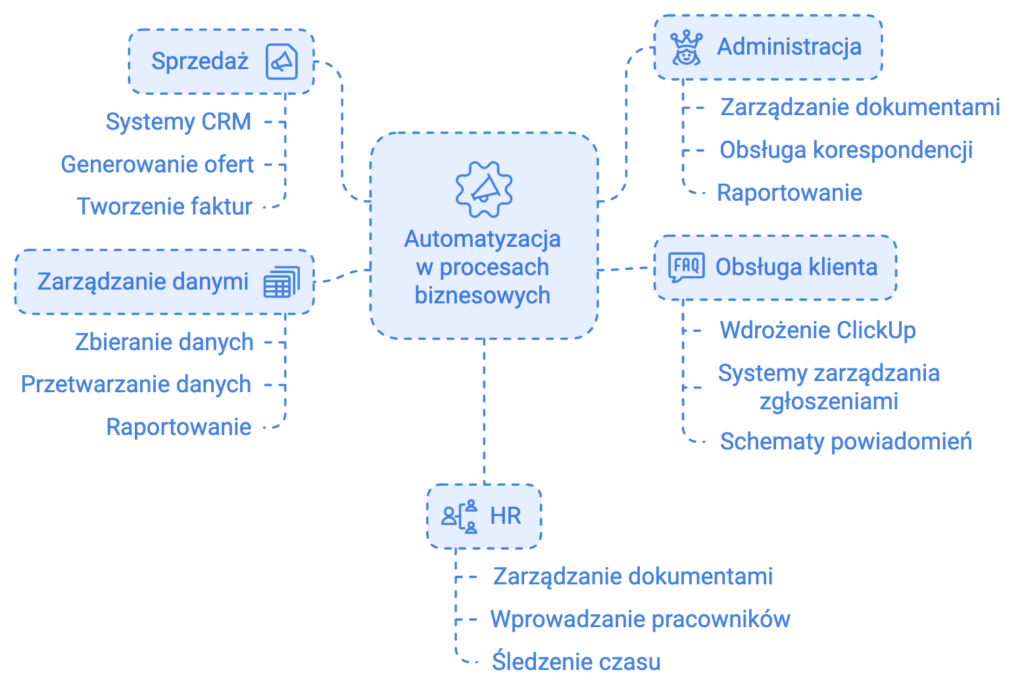
Automation will benefit almost every area of a company’s operations, but some processes are more susceptible to it than others. Here are a few areas where automation is most effective:
Sales automation, or ways to increase sales in your company
The sales department is one of the places where automation can significantly increase efficiency. Automated CRM (Customer Relationship Management) systems, tailored to your company, allow you to manage customer relationships, monitor purchase history or create personalized offers. With BPA, tasks such as generating offers, invoices and contracts are completed in seconds without the need for human intervention. Sales automation effectively shortens the time spent on customer service.
Automation of administration, order and fast implementation of processes
In administration, automation will streamline work related to managing documentation, correspondence, reporting, and other office tasks. Tasks in this department often consist of mostly repetitive activities, making them ideal candidates for automation of administrative processes.
Customer Service Automation, a Solution to Increase Customer Satisfaction
Customer service is an area where speed and quality of response are of invaluable importance. Automation in this department can significantly improve the experience of those using the company’s services while reducing the burden on employees. Excellent examples automation in customer service will include chatbots, notification management systems and designing notification sending schemes:
Automation of collecting and analyzing business data, essential help in managing the organization
Collecting and then analyzing data is the basis for effective company management. Automation allows for the rapid collection of information from various sources and its automatic processing, compilation and reporting. Thanks to this, decision-makers have access to current and accurate data, based on which they can plan further actions.
Automation in HR and Recruiting, a Way to Build Effective Teams
Introduction of Automation in HR and Recruitment Processes
is a chance to significantly improve the efficiency of the HR department. The tools are able to efficiently manage all documentation (including candidate applications and the schedule of recruitment interviews), support during onboarding or monitor working hours. Thanks to this, HR can focus on building a talent management strategy, and employees have a better experience when it comes to cooperation with the company.
When will process automation not work?
Although business process automation undoubtedly translates into many benefits , there are undoubtedly situations in which it is not the most optimal solution. Tasks requiring high creativity, flexibility or complex decision-making or simply human empathy are not always suitable for automation. In industries where interpersonal relationships play a significant role, automation may not bring the expected results. It is also worth noting that if a company has complex and at the same time underdeveloped processes, automation can only intensify existing problems. In the above cases, business process automation will not be a recommended service.
How does business process automation work step by step?
Business process automation is not a quick task. It consists of many stages that will require both technical preparation and organizational adjustment.
Automation and Algorithms: What Should Your Company Know About Them?
Algorithms are the basis for the operation of every system. Thanks to them, the tool can perform planned tasks step by step according to recommendations, taking into account variables that affect the course of processes. The role of algorithms in automation is primarily the maximum optimization of processes by minimizing (preferably to zero) the need for human intervention. A well-designed algorithm will be the basis for performing tasks quickly, flawlessly and consistently, which will allow maintaining a high, uniform standard.
Use integrations to automate your business processes!
Automation requires integration with existing systems. By connecting with tools such as ERP, CRM, accounting systems, bank accounts and other programs and tools, automation allows for real-time data synchronization. Well-executed integrations enable a smooth flow of information and execution of processes requiring the use of various sources.
What are the types of business process automation?

Business process automation is divided into different types. We divide them according to the level of technological advancement and the specificity of the processes.
Intelligent Process Automation (IPA) – what is it?
Intelligent Process Automation (IPA) is an advanced form of automation that includes elements of artificial intelligence. IPA allows you to automate not only simple, repetitive tasks, but also those that require the analysis of large-volume data, forecasting or decision-making based on collected information. This type will work best if, for example, we plan to introduce marketing automation to the organization.
Robotic Process Automation (RPA) – how does it work?
Robotic Process Automation (RPA) is a technology aimed at easy, routine business processes. RPA uses “robots” – software that mimics human actions in a user interface. They perform tasks such as copying data, filling out forms, sending emails or processing orders. RPA is a particularly useful form of automation in situations where interaction with many different systems is necessary without the need for their integration.
Business Process Automation (BPA) – what is it?
Business Process Automation (BPA) is a comprehensive automation that covers entire business processes – simpler and more complex. BPA automates activities on a large scale, covering various departments. The goal of BPA is to optimize tasks so that the company can operate more efficiently, with fewer errors and in a shorter time.
Business Process Automation, How to Be Number 1 in Your Industry?
Competition on the market is becoming increasingly fierce, and companies that want to get ahead of their rivals must focus on innovation and optimization. Automation of business processes is absolutely essential to achieve this goal. By implementing modern technologies, companies can gain an advantage over the competition, overtaking them by a few steps. Thanks to automation, companies are able to quickly respond to changing market conditions, adapt to new trends and better utilize their resources. Using modern systems, a company can monitor its activities in real time, quickly identify problems and immediately make the best possible decisions, better using data. Automation is therefore not only a way to increase current efficiency, but also a tool for building a long-term strategy, the goal of which is to develop and become a leader.
Practical guide from Coders Pilot – How to implement business process automation?

Implementing business process automation is a strategic action that requires thoughtful planning and close cooperation between teams in the company. Automation can radically change the way an organization functions – that is why it is so important to prepare for these changes and implement it with due diligence. This process can be presented in several steps:
Step 1: Analysis of current company processes
Any effective automation starts with a thorough analysis of the activities carried out within the organization and consultations discussing the needs and expectations of employees. Without understanding which business processes in the company are the most problematic, time-consuming and error-prone, it is impossible to design effective automation well. The first stage is to conduct business process mapping. It involves carefully tracking all tasks, identifying their components and assessing which of them can be automated. It is also necessary to determine how the selected processes affect the functioning of the company and what costs they generate.
The analysis takes into account primarily:
- Task completion time
The longer it takes to perform a given operation, the greater the potential savings after automating it.
- Manual work required
Processes that involve many employees or require a lot of work are great material for optimization when implementing automation.
- Human errors
If a process is particularly problematic and error-prone, automation can focus on accuracy, reducing the risk of costly mistakes.
The analysis must also include the needs of all employees involved in the processes – so that automation is best suited to their expectations and actually improves their daily work.
Step 2: Designing business process automation – proposed changes
Once we have identified which business processes are most profitable to automate, we should proceed to step two. Designing automation is a critical moment, because at this stage, the details of how it will work in practice are determined. The key is to simplify processes – it is worth removing unnecessary elements and optimizing the sequence of tasks before they are automated. During the design phase, it is also necessary to select the right technologies.
The questions we are seeking answers to at this stage are:
- Which tools will be best suited to the specifics of business processes?
- Does the company need RPA (Robotic Process Automation) systems that help automate simple tasks, or more advanced solutions such as IPA (Intelligent Process Automation) that can handle complex decision-making processes?
- What integrations will be necessary between systems for automation to run smoothly?
The next step is to create visual maps of the processes after automation, which will help teams understand what the future state of operations will look like. It’s important to involve everyone who will be affected by the change so that their perspective is included in the design.
Step 3: Implementing automation in the company – is the hardest part behind us?
Implementation is the stage where previously designed solutions become a reality for the company. To achieve the best possible results, implementation must be done correctly.
The most important thing will be training your teams. No system will work if your employees don’t know how to use it. So it’s worth investing in training that will help your teams understand:
- how the new system works,
- what are its capabilities and
- how they can use it effectively in their work.
Often the biggest challenge in implementation is the change in work culture – people can be skeptical, especially when they fear for their jobs. It is important to emphasize the benefits of automation, such as relief from routine duties and the ability to focus on more creative, valuable tasks.
Another important element of implementation is testing systems before full launch. This allows for detecting and fixing any errors before automation is implemented on a wider scale.
Once the implementation is complete, it’s time to monitor the results. Regular reviews of the operation of automated processes, analysis of efficiency indicators and verification of savings allow for ongoing optimization of the systems’ operation. At this stage, it is also worth collecting opinions from employees who work with the new tools on a daily basis, in order to adapt the solutions to the real needs of the company.
Is the hardest behind us? In a sense, yes – implementing automation requires commitment, but at the same time, it is only the beginning of the journey. The success of automation lies in the continuous adaptation of systems to changing business needs and further integration with other tools. Thanks to this, the company will not only implement new technologies, but also create a foundation for further development and scaling of its activities.